Netrivo guide
Ad profitability: POAS over ROAS
A strong ROAS can still lose money. Netrivo connects campaign results with margin, COGS, returns and selling costs.
From campaign spend to a decision
- 01
Spend
The advertising provider supplies campaign spend for a defined day and currency.
- 02
Sales and margin
Orders and available selling costs form contribution before advertising.
- 03
Attribution
Spend and sales are joined only within the scope supported by identifiers and the attribution model.
- 04
POAS
Campaign contribution stays paired with coverage, data delay and limitations.
ROAS does not describe the whole economics
ROAS compares attributed revenue with advertising spend. It can look strong for a low-margin product with high fees or expensive returns.
Campaign profitability needs product cost, selling costs and an explicit attribution scope.
POAS and data coverage
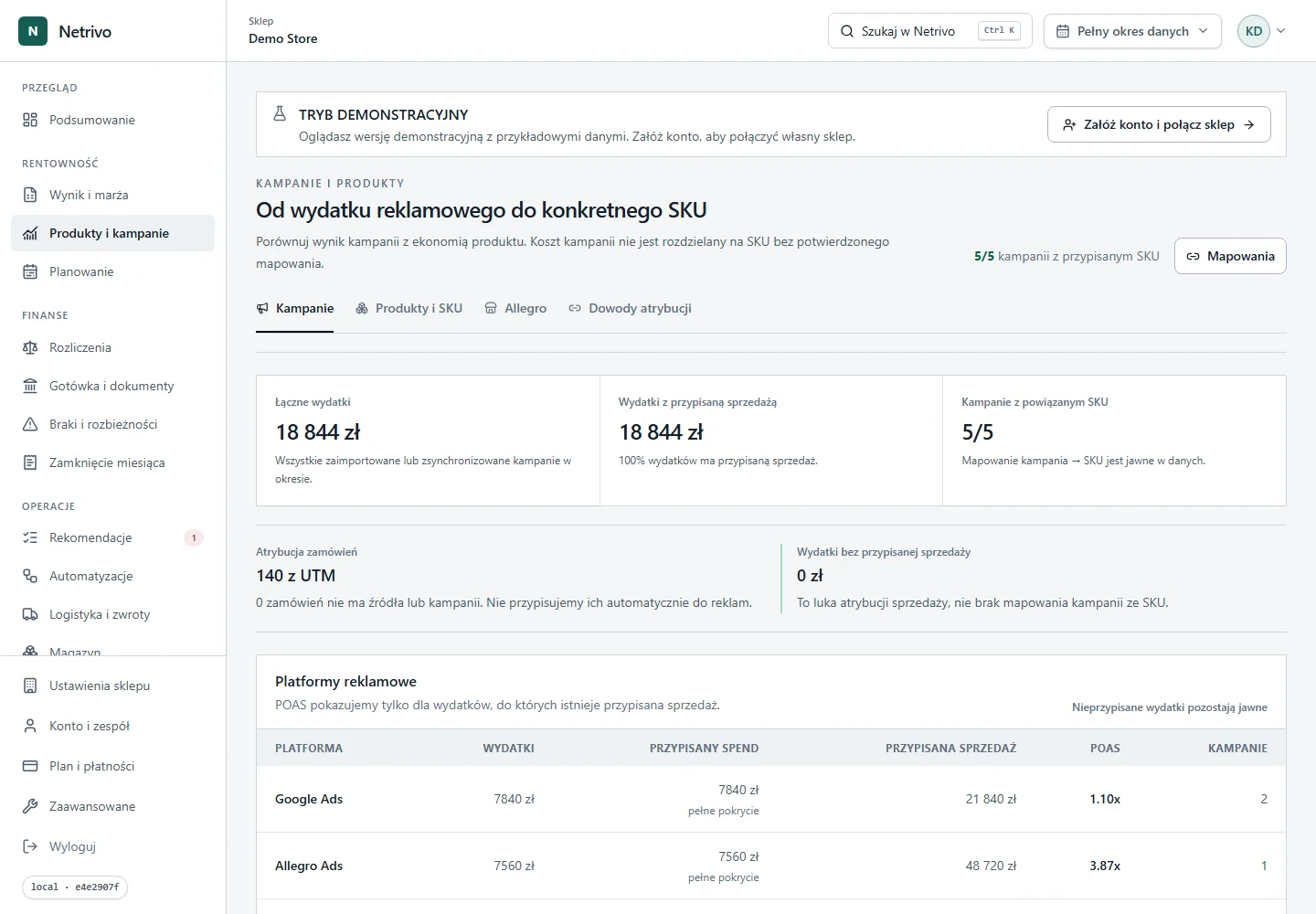
Netrivo POAS compares contribution before advertising with advertising spend. A value of 1.0 marks advertising break-even before operating costs and tax, not guaranteed company profit.
The result is shown together with cost completeness and the attribution period. Missing orders, SKU cost or campaign spend reduce comparison reliability.
- matching sales and advertising periods
- explicit attribution model
- product and selling costs
- returns assigned to the observed period
The scaling decision
Scaling should consider current POAS together with inventory, data delay and a potential efficiency change at higher spend.
A scenario is a hypothesis. Netrivo does not assume that doubling spend will double sales.